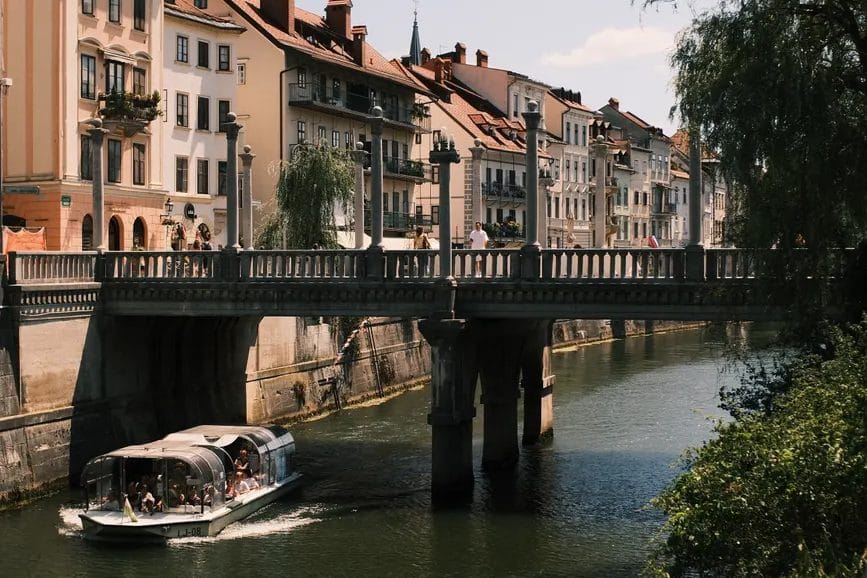
Ljubljana never quite makes anyone's shortlist the way Prague or Vienna do, and after four days walking its old town twice a day, I think that's a mistake on the traveler's part rather than the city's. The entire historic center fits inside a loop you can walk in twenty minutes, the river running through the middle of it lined with cafe terraces on both banks, and a castle on the hill above watching over the whole thing like it's been rehearsing for postcards since the 12th century. September is close to the ideal window — daytime temperatures sit around 20°C, the summer cruise-tour crowds have thinned out, and the outdoor cafe season is still fully alive without the July crush.
Getting in and getting around
Ljubljana Jože Pučnik Airport sits about 25 kilometers north of the city, and the public bus (line 28) into the center runs roughly every 30 to 60 minutes for €4.10, taking about 45 minutes. The faster option is GoOpti, a shared shuttle service that Slovenians actually use themselves rather than a tourist-only operation, running €9–€15 per person depending on how far ahead you book and how full the van is. I'd book GoOpti the night before rather than at the airport counter — same-day bookings run a few euros more and availability thins out on weekend afternoons.
Once you're in the center, you won't need transit again unless you're doing a day trip. The old town, the castle, the riverside market, and most of the museums sit within a 15-minute walk of each other, which is rare enough among European capitals that it's worth saying twice: you can see the highlights of Ljubljana without a single bus ticket if you're staying centrally.
Where to stay and what it actually costs
Hostel Celica is the one place in the city that shows up in every solo-traveler recommendation, and it earns it — a former Yugoslav military prison converted into a hostel and cultural center in 2003, with each dorm room designed by a different artist. Dorm beds run €25–€32 a night depending on season and room size, and private rooms (some literally former cells, deliberately kept small) run €55–€75. It's a fifteen-minute walk from the old town in the Metelkova district, which is also the city's alternative-culture and street-art quarter — worth a wander even if you're not staying there.
Budget hotels in the center run €70–€110 a night for a simple double, and mid-range options with real character — think exposed beam ceilings, a converted 19th-century building — land in the €120–€160 range. Airbnb pricing has crept up in the last few years but still tends to undercut hotels by 15–20% for a studio in the wider center, outside the immediate old-town core where prices spike for the view.
What's actually worth the money
The Ljubljana Card runs €29 for 24 hours (or €39 for 48, €49 for 72) and bundles the castle funicular, most museum entries, a Ljubljana boat cruise, and unlimited city bus rides. Do the math before buying — it only pays off if you're planning to hit at least three paid attractions in a day, and the castle alone plus one museum won't clear the cost. If your itinerary is lighter, skip the card and pay the castle funicular separately: €10 return, or a genuinely pleasant 15-minute uphill walk if you skip the funicular entirely and want the view to build gradually instead of arriving all at once.
Ljubljana Castle itself is honestly more atmosphere than must-see exhibits — the real reason to go up is the view over the terracotta rooftops and the Julian Alps on a clear day, not the museum inside, which is modest. The Central Market, designed by Slovenian architect Jože Plečnik and running along the riverbank each morning except Sunday, is where I'd actually spend an unhurried hour: local cheese, honey from beekeepers who drove in from the countryside, and a fish market under a colonnade that locals actually shop at, not a tourist recreation of one.
Skip the guided walking tour if you're comfortable navigating alone — Ljubljana's old town is small and safe enough that a paper map and an hour of wandering will teach you the layout faster than a group tour will, and you'll stumble onto Tromostovje, the Triple Bridge, and the dragons on Zmajski Most on your own timeline instead of a script.
Eating alone without it feeling like a performance
Odprta Kuhna — Ljubljana's open-air street food market held every Friday on Pogačarjev trg near the Central Market — is the easiest solo meal in the city, running from spring through late October and packed with stalls from actual restaurants rather than generic festival vendors. A plate runs €6–€12, there's no table service to navigate, and eating standing up at a shared high-top table surrounded by locals doing the same thing removes the entire "table for one" awkwardness that sit-down restaurants can carry. For a proper sit-down dinner, Gostilna na Gradu, inside the castle complex itself, serves modernized traditional Slovenian dishes — think žlikrofi, a dumpling similar to ravioli, or venison stew — for €18–€28 a main, and the covered terrace seats solo diners without a second glance.
Slovenian wine deserves more attention than it gets outside the region. The Vipava Valley and Goriška Brda areas, both within a two-hour drive of Ljubljana, produce excellent whites from local grape varieties like Rebula and Malvazija that rarely make it onto export lists — a glass at a wine bar in the old town runs €5–€8, noticeably less than the same quality would cost in Vienna or Munich. Movia and Ščurek are two producers worth asking for by name if a wine list looks unfamiliar.
The day trip that's worth the early alarm
Lake Bled is 50 minutes away by bus and it is, without qualification, worth setting an alarm for. Buses run from Ljubljana's main bus station roughly hourly, round trip around €13–€16 depending on the operator (Flixbus and the regional Nomago line both cover the route). The lake itself — an alpine glacial lake with a tiny island church in the middle and a medieval castle on a cliff above — gets crowded by early afternoon in peak season, so the 7:00 or 7:30 AM bus is the move if you want the famous reflection shot without forty other people in it. A traditional pletna boat out to the island church runs about €14 per person round trip, or you can walk the 6-kilometer lakeside path for free and get nearly the same view without the boat.
Metelkova comes alive after dark in a way the old town doesn't — a graffiti-covered former army barracks turned into bars, live music venues, and a genuinely eclectic crowd. It's safe to walk through alone in the evening; Ljubljana as a whole consistently ranks among the safest capital cities in Europe for solo women, and the police presence in the center is more about parking enforcement than anything else.
What surprised me most wasn't any single sight — it was how little I had to think about logistics the entire trip. No metro map to decode, no long transfers, no neighborhood I needed to research before walking through it after dark. Ljubljana gives you a city that runs on its own quiet schedule and lets you just move through it.