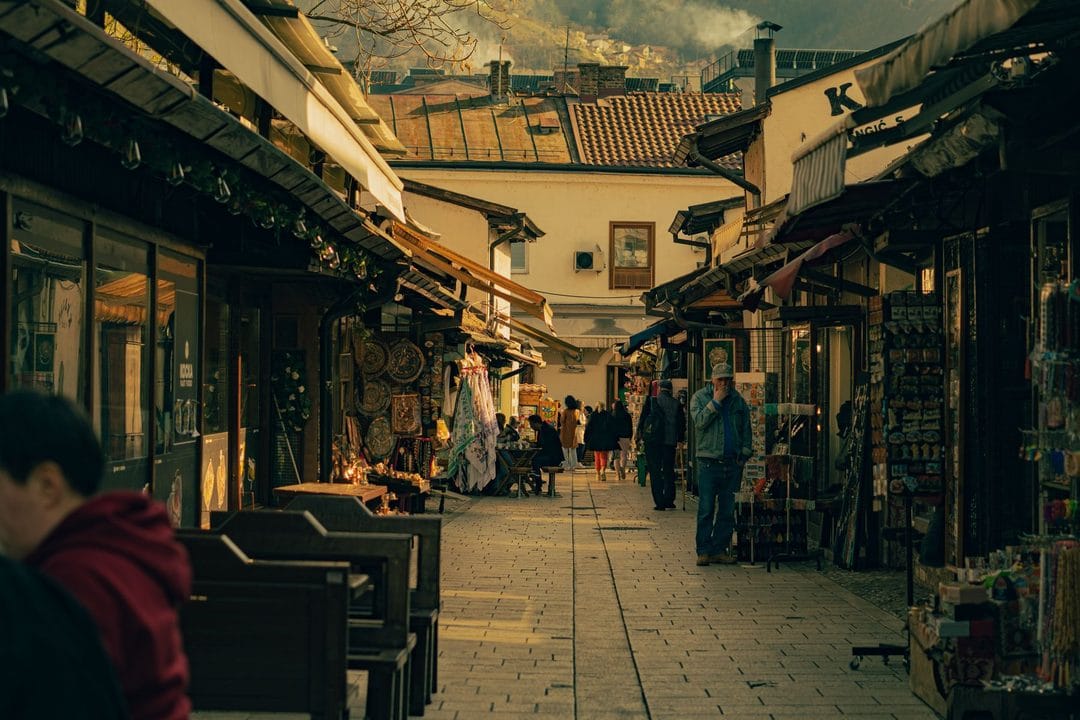
I landed in Sarajevo with exactly one plan: find the minaret my guesthouse host had described as "impossible to miss" and figure out the rest on foot. Twenty minutes later I was sitting on a low stool in Baščaršija, a tiny copper džezva of coffee in front of me, watching a call to prayer drift over a street that had a synagogue on one corner, an Orthodox church on another, and a Catholic cathedral two minutes further on. Nobody had told me this part — that Sarajevo doesn't just claim to sit between East and West, it makes you feel the seam.
The city that refuses to pick a side
Baščaršija, the Ottoman-era old bazaar, is where most solo travelers start and where most end up returning three or four times over a few days. Copper workshops still hammer out đezva sets the way they did under Ottoman rule, and the smell of ćevapi grilling over open flame follows you down every side street whether you're hungry or not. Walk fifteen minutes west, though, and the architecture flips entirely — Austro-Hungarian facades, wide boulevards, a yellow tram system that looks like it belongs in Vienna, because in 1885 it more or less did. Locals call this line the meeting of East and West, and they're not exaggerating for tourists; you can stand with one foot on each side and see the building style change mid-block.
What surprised me more than the architecture was the pace. Sarajevo doesn't rush you toward anything. Coffee here is a forty-minute event, not a to-go cup, and if you try to drink it fast a server will genuinely look concerned. I ordered a Bosnian coffee at a café called Čajdžinica Džirlo on my second morning and the owner sat down at my table uninvited to explain the correct way to eat the rahat lokum that came with it — dissolve a corner in the coffee first, he insisted, don't just bite it. That kind of unprompted hospitality happened almost daily, and it's the single biggest reason I'd send a solo female friend here before somewhere flashier.
What the city still carries from the 1990s
You cannot walk more than a few blocks in central Sarajevo without meeting the siege. Between 1992 and 1996, this was the longest siege of a capital city in modern warfare, and the evidence hasn't been erased — it's been deliberately kept. Sarajevo Roses, the mortar shell scars in the pavement filled with red resin, mark spots where multiple people died; I counted six on my walk from Baščaršija to the river alone. The Vijećnica, the extraordinary Austro-Hungarian city hall and former National Library, burned in 1992 and lost roughly two million books and manuscripts; it reopened fully restored in 2014, and standing inside its striped Moorish-revival atrium now is one of the most moving fifteen minutes I've spent in any European city.
The Tunnel of Hope, out near the airport, is the one site I'd actually build a day around. During the siege this 800-meter hand-dug tunnel under the runway was Sarajevo's only connection to the outside world, moving food, weapons, and people in conditions that are hard to picture even standing in the surviving 20-meter section. Get there by taxi or the number 3 tram plus a short walk — allow half a day, because you'll want time afterward to just sit somewhere quiet.
The Latin Bridge, briefly
Most visitors detour to the Latin Bridge because this is where Archduke Franz Ferdinand was assassinated in June 1914, the spark for the First World War. It's a five-minute stop, honestly, and the small museum on the corner does more explaining than the bridge itself — worth the 4 KM entry if you're already history-minded from the morning, skippable if you're not.
What to actually eat, beyond the coffee
Ćevapi gets top billing in every guidebook, and it earns it — small grilled beef or lamb sausages stuffed into fresh somun bread with raw onion, usually 6–8 KM for a full portion at a proper grill house rather than a tourist-menu café. But the dish I ended up craving more was burek, the spiral of phyllo pastry filled with minced meat (ask for sirnica if you want the cheese version instead), sold by weight at bakeries that open before 6am and sell out by mid-morning. Sarma — cabbage rolls stuffed with rice and meat, simmered for hours — shows up on winter menus and is worth seeking out even if you have to ask around; it's a home-cooking dish more than a restaurant staple, so not every café bothers with it. For dessert, tufahija, a whole poached apple stuffed with walnuts and topped with whipped cream, is sweeter than it sounds and pairs unreasonably well with a second round of that slow coffee.
Buregdžinica Bosna, just off the main Baščaršija square, is the burek stop locals actually queue at rather than the ones with English menus posted outside. Go before 9am if you want a full selection — by noon the good fillings are often gone, and that's not a complaint, it's a sign the place isn't cooking for tourists.
Solo, female, and never once felt unsafe — with one caveat
So is Sarajevo actually safe for solo women, or is that just guidebook reassurance repeated until it sounds true?
I'd rate Sarajevo among the more comfortable cities I've traveled through alone, on par with Ljubljana rather than anywhere I'd file under "high alert." Bosnia and Herzegovina has low violent crime rates for tourists, the old town stays lively and well-lit well past midnight, and I walked back to my guesthouse near Baščaršija at 11pm on three separate nights without a single uneasy moment. Solo women dining alone are common here rather than remarkable, which after a few countries where that's not true, is genuinely restful.
The one real caveat isn't about people at all — it's about land mines left over from the war, still present in rural and forested areas outside marked paths, including some hiking trails on Mount Trebević above the city. Stick to signed trails, don't wander off-path chasing a photo, and you'll be fine; the danger is real but entirely avoidable if you're not improvising your own route through unmarked terrain.
Trebević itself is worth the detour regardless. The cable car up — rebuilt in 2018 after sitting destroyed for over two decades — drops you at the abandoned 1984 Winter Olympics bobsled track, now covered floor to ceiling in graffiti and genuinely eerie to walk through alone at golden hour.
Money, sleeping, and getting fed
Bosnia's convertible mark (KM or BAM) is pegged to the euro, which makes mental math easy: roughly 1.95 KM to €1. This is one of the cheapest capitals I've covered on this blog. A private room in a well-reviewed guesthouse in Baščaršija runs 40–60 KM (about €20–30) a night, a full ćevapi lunch with bread and yogurt costs 6–8 KM, and that unhurried Bosnian coffee I mentioned earlier rarely tops 2 KM. Bring cash for the old town's smaller cafés and stalls — cards work at restaurants and hotels, but the copper workshops and coffee stands often don't take them.
Skip the big international hotel chains near the river if you can. Book a guesthouse actually inside Baščaršija instead — you'll pay less and wake up to the call to prayer and the coppersmiths starting work, which is honestly the whole reason to come.
- Sarajevo International Airport (SJJ) connects directly to Vienna, Istanbul, Munich, and several other European hubs
- Buses from Zagreb (about 8 hours) and Belgrade (about 7 hours) are reliable and comfortable, run mostly overnight
- Mostar is a 2-hour bus ride south and pairs naturally with Sarajevo — most solo travelers do both in one trip, and honestly you should
Three days is enough — and also not nearly enough
I gave Sarajevo three full days and left feeling like I'd only opened the door. Two days covers the essentials comfortably: Baščaršija and the Vijećnica on day one, the Tunnel of Hope and Trebević on day two. The third day is the one you should actually protect, because it's when you stop sightseeing and start just being in the city — sitting with coffee longer than planned, following a side street because it looked interesting, letting a shopkeeper's uninvited history lesson run twenty minutes past when you meant to leave. That third day is where Sarajevo actually gets you.