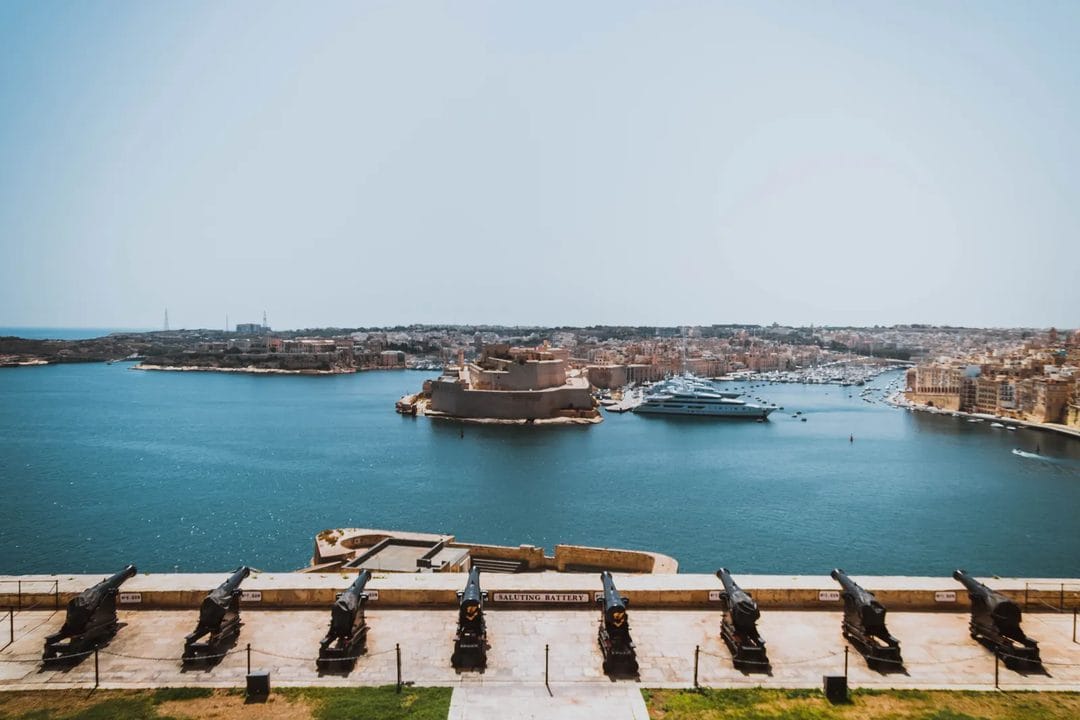
I landed in Malta expecting a stopover country and stayed nine days, most of them inside a capital city you can walk end to end in twenty-five minutes. Valletta measures roughly 0.55 square kilometres — smaller than most airport terminals — and it took me until the second morning to stop treating that as a limitation. It isn't one. A city this size means you stop planning routes and start just walking wherever the light looks best, which by late September in Malta is most of the day, since the sea keeps the heat down to somewhere in the high twenties Celsius instead of the mid-thirties you'd have got in July.
September is the month Maltese hoteliers quietly admit they prefer to August, and after four days there I understood why. The cruise ships that dock at the Valletta Waterfront in summer taper off sharply after the first week of the month, the ferry to Sliema runs the same reliable schedule without the queues, and restaurant owners in Republic Street actually have time to tell you which fish came in that morning instead of just pointing at the laminated menu. Peak season Malta and shoulder season Malta are close to two different cities wearing the same limestone.
Where the whole city actually is
Valletta was built by the Knights of St John in the 1560s on a rectangular grid across a peninsula between two natural harbours, and that grid is the reason it's such an easy solo city to find your way around — you're never more than two streets from either water's edge, and the honey-coloured limestone that makes up basically every building turns a genuinely different colour depending on the hour. At 8am it's pale gold. By 6pm, standing at the Upper Barrakka Gardens looking across the Grand Harbour to the Three Cities, it's gone the colour of a dying campfire, and there's a small crowd of locals and travellers who show up every evening just for that, not for the noon-day gun cannon that fires below (though that's worth timing your visit for once, purely for the theatre of it).
St John's Co-Cathedral is the one paid attraction I'd actually tell you not to skip, and I say that as someone who generally avoids ranking cathedrals. The exterior is plain enough that you'd walk past it; the interior is carved, gilded, and painted floor to ceiling in a way that makes the Sistine Chapel comparison, which every guidebook makes, feel less like hyperbole once you're standing under it. Entry runs around €15 as of this year, and it includes an audio guide that's genuinely worth using — the floor itself is made of over 400 inlaid marble tombstones, and without the guide you'll walk over most of the story without noticing it's there.
Solo dining without the awkward table for one
Malta doesn't have the solo-dining stigma some Mediterranean countries still carry, and Valletta specifically is full of small counter-style and bar-seating spots built for exactly one person with a book. Legligin on Melita Street runs a proper Maltese small-plates menu — bigilla, gbejniet, rabbit stew in miniature — that's designed to be ordered three or four dishes at a time even solo, and the bar seating means you're never given the two-top by the kitchen door that solo diners get stuck with everywhere else. For something faster, the pastizzi shops scattered through the side streets sell the ricotta or mushy-pea pastries for around 60 cents each, which is less a meal than a standing snack, and nobody blinks at a solo traveller eating one on a step.
Prices across Malta sit noticeably lower than most of Western Europe — a sit-down dinner with a glass of wine runs €20–€30 in Valletta proper, and that's before you factor in that Malta uses the euro but never quite feels priced like it. The catch, and there's always one: card machines still go down occasionally in smaller family-run spots, particularly in the older side streets, so carry at least €40–€50 in cash for a few days as backup rather than assuming contactless will cover everything.
Day trips that don't require a rental car
The ferry network here does most of the work a car would elsewhere. The Valletta–Sliema route runs every twenty to thirty minutes and costs €3.30 one way, dropping you into a completely different register of the same small country — modern promenade, seafront bars, a different pace entirely. Gozo, Malta's quieter sister island, is reachable via a combination of bus and ferry in about ninety minutes total, or a direct Valletta harbour cruise transfer in summer months (worth checking if it's still running in late September, since the schedule thins as the season winds down). I'd give Gozo a full day rather than a rushed half — the Azure Window collapsed in 2017, so skip anyone still marketing tours around it, but the Dwejra coastline and the Citadella in Victoria more than cover the gap.
What I wouldn't do is try to see Malta, Gozo, and Comino's Blue Lagoon in a single trip if you're only in the country for four or five days. Comino in particular gets mobbed by day-trip boats from both Malta and Gozo even in shoulder season, and the lagoon that looks empty in every photo online is rarely empty in person before 10am. Pick two of the three islands and actually spend time on them instead of collecting all three at a sprint.
Where solo travel in Malta gets genuinely easy
English is an official language alongside Maltese, a leftover from British colonial rule that ended in 1964, which means every menu, sign, and conversation with a stranger happens without the small daily friction of translation. That alone changes how a solo trip feels — you're never doing the mental math of ordering in a second language, and asking a local for a recommendation is as easy as it would be at home. Combine that with a country small enough that public transport genuinely reaches everywhere, and Malta ends up being one of the lowest-friction solo destinations in the Mediterranean, not because nothing goes wrong, but because when something does, sorting it out doesn't eat your afternoon.
Base yourself in Valletta itself rather than Sliema or St Julian's if solitude with easy walkability is what you're after — the capital empties out noticeably after the day-trippers leave in the evening, which some travellers find eerie and I found exactly the point. A city built for a few thousand residents, with the harbour lights coming on across the water and half the streets to yourself, is a strange kind of company. It's the version of solo travel where you stop checking your phone for something to do, because for once there isn't a decision left to make.
Getting there and getting around
Malta International Airport sits about a 25-minute bus ride from Valletta, and the X4 airport express runs directly into the capital for €2 with a rechargeable tallinja card, which also covers every bus and ferry on the island for the length of your stay — buy one on arrival rather than paying cash fares each time, since the card rate works out roughly 40% cheaper over a week. Skip the airport taxi touts entirely; the bus runs every twenty minutes until close to midnight and drops you within a five-minute walk of most Valletta accommodation, since cars aren't allowed past the city gates anyway.
Accommodation inside the Valletta walls tends to mean a converted 17th-century townhouse rather than a standard hotel block, and that's worth seeking out deliberately — a mid-range guesthouse room with the original stone vaulting runs €70–€100 a night in late September, not far off what you'd pay for something far less characterful in Sliema. Book one with a roof terrace if you can find it; half the pleasure of staying inside the old city is having your own quiet slice of that harbour view without walking anywhere at all.