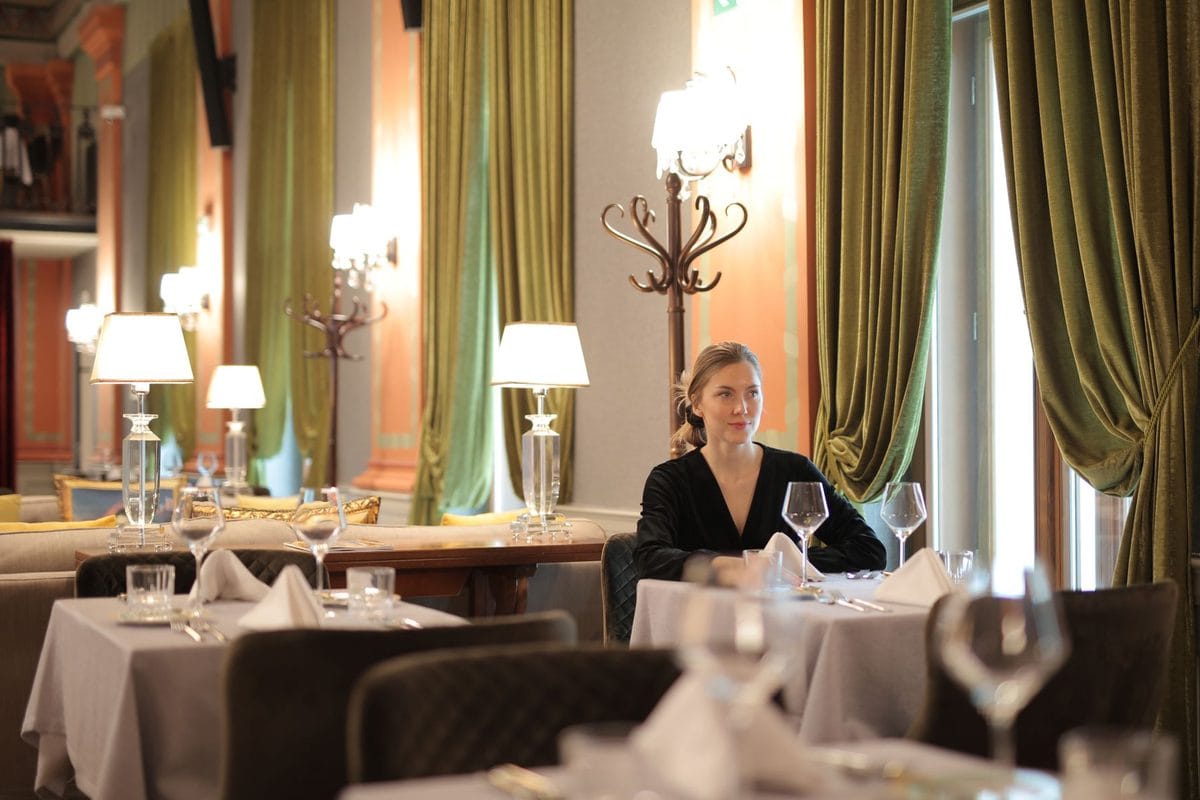
Booking the flight is the easy part. So is choosing the hotel, packing the bag, even working out the trains. The thing that actually keeps women from travelling alone, the bit nobody puts on a packing list, is dinner. Specifically, the moment you push open the door of a busy restaurant on a warm June evening, the host looks past your shoulder for the rest of your party, and you have to say the words: just me.
I have eaten alone in maybe a dozen countries by now, from a packed trattoria in Bologna to a 6am noodle counter in Osaka, and I can tell you the dread fades faster than you'd think. It also never fully disappears, and that's fine. What changes is that you stop treating the empty chair across from you as a verdict on your life and start treating dinner as the best ninety minutes of your day. Here's what actually makes that shift happen.
The first meal sets the tone, so make it an easy one
Your very first solo dinner in a new place should not be the candlelit tasting menu you've been dreaming about. Save that. On night one you are jet-lagged, slightly disoriented, and far more self-conscious than you'll be by night three. Pick somewhere with a counter, a bar you can sit at, or communal tables, because the geometry of those spaces does half the work for you. Nobody reads a woman at a bar as lonely. She's just at the bar.
In Spain this is almost cheating. Walk into any decent tapas bar in San Sebastián or Seville around 8pm, stand at the counter, point at the pintxos under the glass, and order a glass of txakoli for around 3 euros. You eat standing up, shoulder to shoulder with locals doing exactly the same thing, and the whole transaction takes fifteen minutes. There is no table, no empty chair, no performance. It is the gentlest possible on-ramp to eating alone, and by the time you've done it twice you'll wonder what you were so worried about.
Where you sit matters more than what you order
Ask for the right seat and you change the entire experience. Most hosts will seat a solo diner at the worst table in the room out of pure habit, the one by the toilet or wedged against the service station, because they assume you want to be invisible. You don't have to accept it. A friendly "could I sit at the bar?" or "is that little table by the window free?" almost always works, and staff usually prefer it because it frees up a two-top for a couple.
What you're looking for, in order:
- A bar or counter where you face the kitchen, the bartender, or the street. Watching people cook is the most natural distraction in the world.
- A window seat. You become a person watching the street rather than a person sitting alone, and those are two completely different things to the part of your brain that's worried.
- A communal or shared table, common in Germany, Austria, and a lot of newer places everywhere. You're alone but not isolated, and a "is this seat taken?" can turn into an actual conversation if you want one.
- Failing all of that, any table where your back is to a wall and you can see the room. It sounds like tactical advice, and it sort of is, but it just feels better.
Avoid the dead centre of a large dining room. That is the only seat that genuinely feels exposed, and there's no reason to take it.
The phone is a crutch, and that's allowed
Somewhere along the way, solo-travel advice got militant about not looking at your phone during meals, as if scrolling were a moral failing. Ignore that. Your phone is the single most useful prop you have, and using it does not mean you've failed at being present.
That said, there's a difference between hiding behind a screen and using one well. Reading actual news, messaging a friend a photo of your plate, jotting trip notes, or reading a book on a Kindle app all keep your hands and eyes busy in a way that reads as content rather than anxious. Doom-scrolling the same three apps reads as exactly what it is. The trick I've settled on: order, then put the phone face-down until the food arrives, and use those few minutes to just watch the room. The discomfort of having nothing to do is the muscle you're actually training. After a week it's gone.
Dining alone country by country
The hard truth is that solo dining is wildly easier in some cultures than others, and pretending otherwise just sets you up for a bad night. Knowing the local baseline before you go means you stop reading neutral cultural norms as personal rejection.
Japan: the gold standard
Nowhere on earth makes eating alone easier than Japan. Ramen counters, sushi bars, and entire chains like Ichiran are built around the solo diner, sometimes literally with individual booths and a curtain so you never make eye contact with another human. A bowl of ramen runs you maybe 900 to 1,200 yen, you order from a vending machine, and the staff treat a woman eating alone at 9pm as the most ordinary thing in the world, because it is. If your confidence needs a boost, start your solo-travel career here.
Italy, Spain, France: warmer than their reputation
Southern Europe has a reputation for being family-and-couples territory, and the long romantic dinner does exist. But the counter culture is just as strong. An Italian woman will happily stand at a bar with an espresso and a cornetto, or perch at the end of an osteria's bar with a glass of Lambrusco. French bistros seat solo diners constantly, especially at lunch, where the prix fixe at around 18 to 25 euros is one of the great deals in European travel. The one thing that catches people out: in Italy and France, lingering is expected, not rude. Nobody is waiting to flip your table.
Northern Europe: practical and unbothered
Germany, the Netherlands, the Nordics, the UK. Nobody here will so much as blink at a woman eating alone, and communal tables at beer halls and food markets make it genuinely sociable. The flip side is that service can be brisk to the point of feeling cold if you're used to chattier places. It isn't rudeness. It's just the register.
The places that take more nerve
In parts of South Asia, the Middle East, and some of rural Southern Europe, a woman dining alone in the evening is still unusual enough to draw glances. That doesn't make it unsafe, and it absolutely doesn't mean you shouldn't go. It means lunch is often the smarter solo meal, hotel restaurants are a low-friction option, and a recommendation from your accommodation about which places are used to solo women travellers is worth getting before you set out.
Order like you mean it
One small thing rebuilds more confidence than any seating trick: order with conviction. Ask the waiter what's good tonight. Order the thing you actually want, including the dessert and the glass of wine, not the quick safe pasta you'd never order at home. A woman who clearly knows what she wants and is enjoying herself doesn't read as lonely to anyone in the room, least of all herself.
And here is the part nobody warns you about, the genuinely good part. A table for one is the only meal where you answer to no one. You eat at your pace, you people-watch without guilt, you order three courses or one perfect plate, and you leave the second you're done. After a few trips you start to actively want it. The empty chair stops being something you apologise for and becomes the whole point.
Start with the counter in Spain or a ramen bar in Japan. By your third dinner abroad, you'll be the woman by the window who looks like she's exactly where she means to be, because you will be.