Bergen greeted me the way everyone said it would: sideways rain, grey harbor water, and a woman at my guesthouse handing me a spare umbrella before I'd even said where I was headed. "You'll need this more than your map," she said. I'd read the statistic before booking — Bergen gets rain roughly 240 days a year, more than almost any city in Europe — and I'd half-expected it to ruin the trip. It didn't. By the second afternoon I'd stopped checking the forecast entirely, which turned out to be the single best decision of the whole week.
Why Bergen, Not Just Oslo
Most first-time solo trips to Norway start and end in Oslo, and I understand the instinct — direct flights are cheaper, the city is flatter and easier to get around alone, and nobody has to explain to their group chat why they picked the rainy one. But Oslo is a capital doing capital-city things: government buildings, a design museum, restaurants that book out weeks ahead. Bergen is a working port city wedged between seven mountains, and it feels like it — fish stalls next to fintech offices, hiking boots on the tram, funiculars running up into cloud cover on a Tuesday morning like it's nothing. Locals will tell you, unprompted, which mountain they're climbing after work, the way people elsewhere mention the gym. The city center is small enough to walk end to end in twenty-five minutes, yet it never quite feels small, because every second street ends in either water or a hillside. I picked Bergen over Oslo specifically because I wanted a solo trip that didn't feel like a checklist of museums, and three mountains, a fjord, and a UNESCO wharf inside one compact city delivered exactly that.
I flew into Bergen Airport Flesland and took the Bybanen light rail straight into the center — about 45 minutes, 45 NOK one-way, no faffing with airport shuttles or taxi negotiations. If you're coming from Oslo instead, the Bergensbanen train is worth doing at least once in your life: seven hours across the Hardangervidda plateau, past snow in July, for as little as 500 NOK if you book the Minipris fares a few weeks out. Full-price same-day tickets run closer to 1,000 NOK, so this is one case where planning ahead actually pays for itself rather than just sounding responsible.
Bryggen and the Wharf That Refuses to Look Real
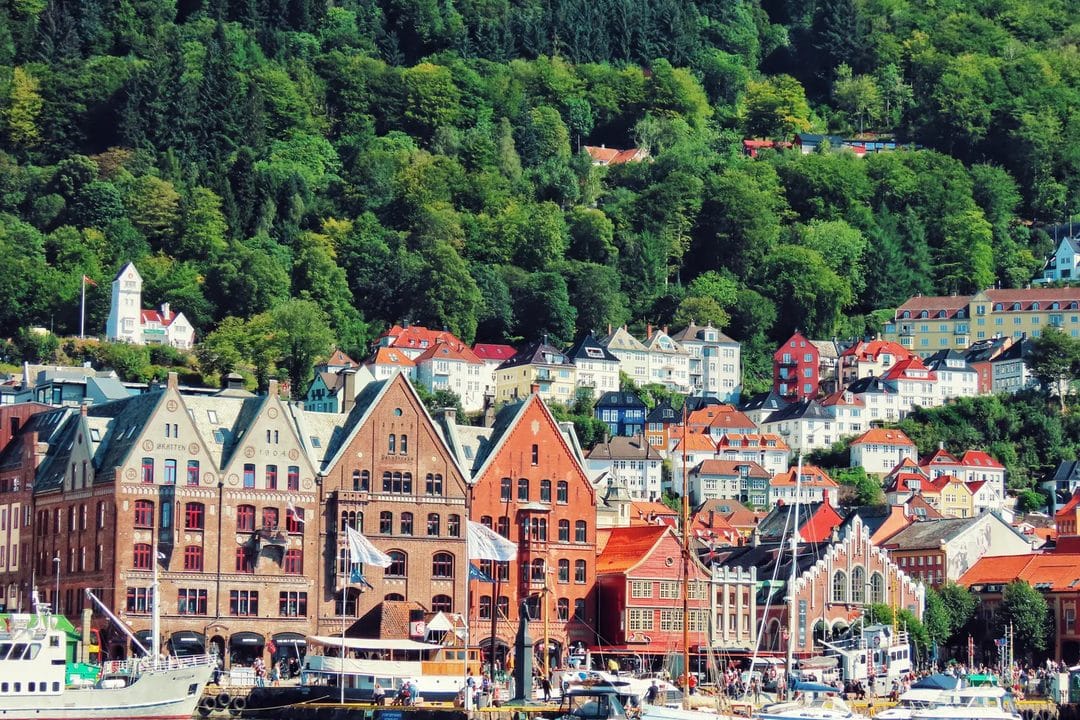
Bryggen is the reason Bergen shows up on every "most colorful cities" list, and it earns the reputation more than most UNESCO sites manage. The wooden wharf buildings — leaning slightly, painted ochre and red and mustard yellow, rebuilt after fires in 1702 and 1955 but standing on the same foundations since the 1300s — were the Hanseatic League's trading post for four centuries. Walk the narrow passages behind the front row (locals call them svitter) and you're in a maze of tar-black timber, uneven floors, and tilted doorframes that no modern building code would ever approve.
Go early, before 9am, if you want photos without forty other tripods in the frame. I went back at 8pm instead, on purpose, and had the whole wharf nearly to myself in that flat Nordic evening light that doesn't fully commit to sunset until close to 11pm in July. The Hanseatic Museum inside one of the original merchant houses (entry 150 NOK) is worth the half hour if you want to understand why this particular stretch of wood mattered enough to survive two fires and six hundred years — skip it if you're short on time and just want the walk.
Getting Above the Rain: Fløyen and the Funicular
Bergen's weather forecast changes by altitude, not just by the hour.
The Fløibanen funicular runs from the city center straight up Mount Fløyen every 10–15 minutes, and it is, without exaggeration, the best 179 NOK you can spend in Bergen (round trip; one-way is 129 NOK). Six minutes of track, a 320-meter climb, and you come out above the cloud line more often than you'd expect — I hit blue sky at the top on a day when the harbor below was fully socked in.
From the summit platform you can turn around and go straight back down, which most tourists do, or you can keep walking. I'd push you to keep walking. The trail toward Skomakerdiket lake is flat, easy, and takes maybe 40 minutes round trip past goats that genuinely live up there and don't care about you. If you want something harder, the ridge trail to Rundemanen adds another two hours each way with real elevation gain and views out toward Ulriken, Bergen's other mountain, accessible by its own cable car (Ulriken643, 410 NOK round trip) on the opposite side of the city.
Do both mountains if you have the legs and the budget. Don't do both in one day — I tried, and by the time I reached Ulriken my knees had filed a formal complaint.
The Fish Market, and Where I Actually Ate
Fisketorget, the fish market by the harbor, is gorgeous and photographs beautifully and is, frankly, a tourist-price trap. A bowl of fish soup there runs 189–229 NOK and is perfectly fine but not remarkable. I ate better and cheaper twice: once at Naboen, a neighborhood spot in Sandviken serving Norwegian home cooking (their fiskekaker — fish cakes — with brown butter and peas, around 245 NOK, is the best thing I ate in Bergen), and once standing at the counter of a Rema 1000 grocery store eating gravlaks on rye for about 60 NOK, which sounds like a joke but genuinely wasn't.
Coffee culture here rivals anywhere in Scandinavia. Blom, near the fish market, does a filter coffee that's worth the 45 NOK on its own, and it's one of the easiest places to sit alone with a book for an hour without anyone treating you like you're waiting for someone. That's a small thing, but if you've traveled solo before, you know exactly why it matters.
Solo Logistics: Trains, Money, Staying Safe
Norway ranks consistently among the safest countries in the world for solo women travelers, and Bergen specifically felt that way even walking back from dinner alone at 10pm with the sky still half-lit. The center is compact enough to cover on foot, well-lit, and the Bybanen runs until around midnight on weekends. I never once felt the low-grade vigilance I carry automatically in bigger European cities.
What Norway is not, is cheap — and pretending otherwise does new solo travelers no favors. A modest hotel room runs 1,400–1,900 NOK a night; a hostel dorm bed at Bergen's Skansen guesthouse is closer to 400–500 NOK and, unusually for a hostel, comes with a genuinely good view over the wharf. I budgeted 900 NOK a day for food and came in slightly under it by leaning on grocery-store lunches and saving restaurant meals for dinner. A single bus or Bybanen ride costs 45 NOK, though a 24-hour ticket at 100 NOK pays for itself after two trips, and I bought one most days once I started climbing mountains I didn't want to walk back down from. Card payment is accepted literally everywhere, including at market stalls and public toilets, so there's little reason to carry more than a small amount of cash. My total for four days, flights excluded, landed around 6,800 NOK — roughly 630 USD — which sounds steep until you compare it to a similar week in Paris or Copenhagen and realize it isn't, actually, that far off.
The Fjord Day Trip Worth the Money
Everyone will tell you to do the "Norway in a Nutshell" tour — train to Voss, bus to Gudvangen, boat through the Nærøyfjord, train back through Flåm. It's a full day, it costs around 1,500–1,800 NOK depending on the season, and it is, unlike most things marketed that hard to tourists, actually worth it. The Nærøyfjord section is a UNESCO World Heritage site for a reason: cliffs rising almost straight out of black water, waterfalls you pass close enough to feel the spray, and a silence on the boat deck that a busload of chattering tourists somehow can't quite break.
Book it two or three days ahead in July and August rather than the day before — summer sailings do sell out, and the alternative sailings run at times that eat into your last full day in the city. I'd also say: bring more layers than you think you need. The boat deck in an open fjord is cold even in August, and the covered lower deck has worse views, and I watched at least four people quietly regret their light jacket around the halfway mark.
What I'd Tell Someone Booking This Trip
Four days is close to the right amount of time — three feels rushed once you add the fjord day, five gives you a cushion for weather, which you will need. Go in August if you can, when the Bergensbanen still runs its full daylight schedule and the funicular queue moves fast, but don't let a forecast full of rain icons talk you out of it. The version of Bergen I remember most isn't the one hour of blue sky at the top of Fløyen — it's the wharf at 8pm in a drizzle, empty and lit gold anyway, looking exactly like it has for three hundred years.