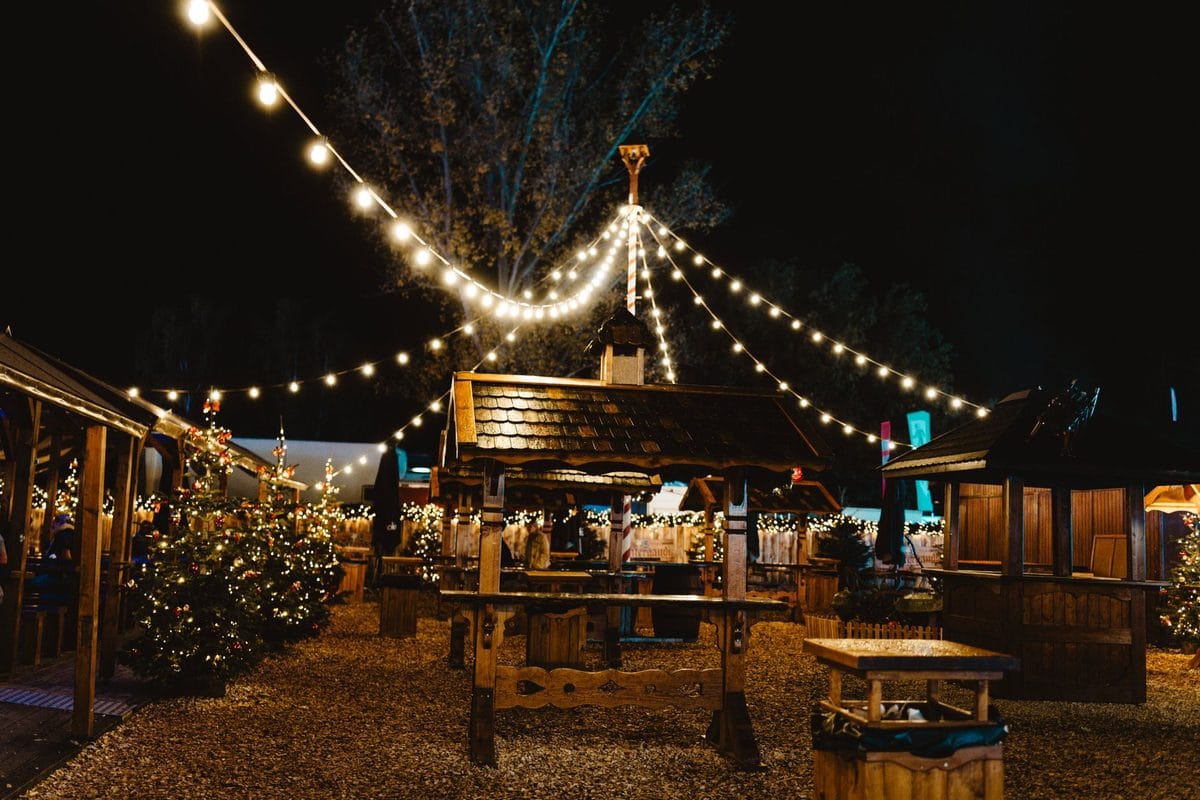
When the Christkind steps out above the crowd at Nuremberg's Frauenkirche at 5:30 pm on Friday 27 November to recite the prologue that opens the Christkindlesmarkt, the sun will already be down. That is the first thing to understand about a Christmas market trip: it is an evening event in the shortest days of the year, and the plan that works is built around the dark rather than around the opening hours. On 1 December the sun rises in Nuremberg at 7:49 am and sets at 4:19 pm, which leaves 8 hours and 29 minutes of daylight, and in Strasbourg the same evening it goes at 4:35 pm. Both cities open on that Friday, the day after US Thanksgiving, which makes the first weekend an obvious target for visitors from the States and an obvious one to avoid if you want any elbow room. The dates are fixed and the markets are easy to reach, so what you are really booking in early October is a day of the week and a bed within walking distance of the stalls. Get those two choices right and a solo December trip is easier than most, because everything happens outdoors, in public, at counters where standing alone with a hot drink is exactly what everyone else is doing too.
Three markets, three different evenings
Vienna: the early one
The Wiener Christkindlmarkt on Rathausplatz opens on Friday 13 November and runs until Saturday 26 December, daily from 10 am to 10 pm, closing at 6:30 pm on 24 December. It starts two weeks before Nuremberg and Strasbourg, so it is the best pick if you would rather see the lights without the opening-weekend crush. An ice rink, the Eistraum am Christkindlmarkt, shares the square from 13 November until 6 January 2027, and skating alone is as unremarkable as eating alone. If you want the city at a different pace, our piece on Vienna's wine taverns in autumn covers it earlier in the season.
Nuremberg: the compact one
The Christkindlesmarkt runs from 27 November to 24 December, every day from 10 am to 9 pm, on the Hauptmarkt in the old town. The city's own site calls it one of the oldest and most famous Christmas markets in the world, and its wooden stalls have given it the nickname "the little city of wood and cloth". Eat the local thing: three Nuremberg bratwursts in a bread roll, known as drei im Weckla, which can be eaten standing up with one hand and is the easiest solo meal on the square. Buy the gingerbread (Lebkuchen) last, on your way out, because a tin carried round the square for two hours is nobody's idea of fun.
Strasbourg: the spread-out one
The city's Noël à Strasbourg site confirms that the 2026 edition opens on Friday 27 November. Over 300 wooden chalets are scattered across different squares, and the city lists eight separate markets, among them the Christkindelsmärik, which the Alsace tourism site says has been running for four centuries. Nothing here is one big square you can take in at a glance, so you will be walking between pockets of stalls in the dark, and that is the practical reason to sleep in the centre of Strasbourg and not at the edge of it.
For a first solo market trip, choose Strasbourg, but go midweek in December and skip the opening weekend. It gives you somewhere to retreat to when the crowd thickens: the cathedral, the café-lined streets around it, the canals. Nuremberg is compact enough to see in a couple of hours, which suits a weekend and leaves the rest of the evening to fill.
Read Strasbourg's crowd table, then borrow it
Strasbourg's official site publishes a crowd table built from past years, rating each hour from 11:30 am to 9 pm as low, medium or strong. Monday, Tuesday and Thursday are rated low all day, which makes them the only days when you can turn up at any hour and expect room to walk. Wednesday turns medium from 2 pm and Friday turns medium from 4 pm. Saturday is medium until 1 pm and strong from then until closing. Sunday is strong from 11:30 am until 6 pm and eases to medium for the last three hours. The city's own advice is to come early in the morning for photographs without people in them, or on a weekday at the end of the afternoon for the warm atmosphere without the weekend crush.
So should you simply go on a Tuesday at noon? Not quite. Whether the same pattern holds in Nuremberg and Vienna is an inference, since neither publishes anything comparable, but weekends are the busy time at nearly any market and I would not bet against it. The quietest slot is also not the best one: the stalls are at their most atmospheric after the light goes, so for most people the sweet spot is a Monday, Tuesday or Thursday between about 4 and 6 pm, when you arrive in daylight and watch the lights come on around you.
Planning around the dark
Between 1 and 19 December the sun sets in Nuremberg between 4:16 pm and 4:19 pm, with the earliest sunset on 11 or 12 December. By the time the market closes at 9 pm the sun will have been down for more than four and a half hours, and Vienna's market stays open an hour later than that. A few habits make the evening easy rather than tense.
- A room within a short walk of the market square, on a street that stays lit and busy until the stalls close; paying more for it is the best safety spend of the trip.
- Carry your bag across your body and in front of you once the crowd thickens, because slow queues for mulled wine are where pickpockets work in any European city.
- Main meal early, at a proper restaurant before 6 pm, with the stalls kept for the snack and the drink.
- Keep your phone above 50 per cent before you step outside, since cold drains batteries faster and both your map and your ride home live on it.
The mulled wine itself comes in a deposit mug at most German markets. Expect to leave a few euros on top of the price of the drink, which is refunded when you hand the mug back, or you can keep it as the souvenir that fits in a coat pocket.
Border checks: what changed since your last trip
If your last European trip was before late 2025, one thing will be different: the border. The EU's Entry/Exit System has been fully operational across all Schengen countries since 10 April 2026, according to the European Commission. It applies to all non-EU nationals on a short stay of up to 90 days in any 180-day period, which covers US, UK and Australian passports alike. You do not apply in advance: at the external border your passport details are recorded, your facial image and fingerprints are taken, and your entry and exit are logged.
The Commission says you can pre-register within 72 hours before entering using its "Travel to Europe" mobile app, which speeds up the check, although not every country uses the app, so look at the list on the official site before you rely on it. ETIAS, the separate online travel authorisation for visa-exempt visitors, is a different story. In April the Commission was still pointing to the last quarter of 2026; the official ETIAS site now says only that the system is not in operation, that no applications are being collected and that the start date will be announced several months before launch. The fee, when it arrives, is €20. Use only the official EU site and app when it does, because the Commission itself warns that third-party sites may charge extra fees or misuse your data.
What to book this month, in order
- The night. Decide on a Monday to Thursday if your leave allows it, and treat Saturday evening as the one to give up.
- The room, on a free-cancellation rate. Rooms near the squares tend to go first for the opening weekends, and a refundable booking costs you nothing if a better date turns up.
- The train. Deutsche Bahn's pages for its cross-border saver fares to France and Denmark both say tickets go on sale up to six months ahead, so December is already bookable on those routes; check domestic and Austrian fares yourself, because the rules differ.
- A reminder in your calendar for 72 hours before you fly, to pre-register for the border check in the app if your arrival country supports it.
Book the weekday, book the room that cancels for free, and leave the Saturday evening to the people who like it shoulder to shoulder.