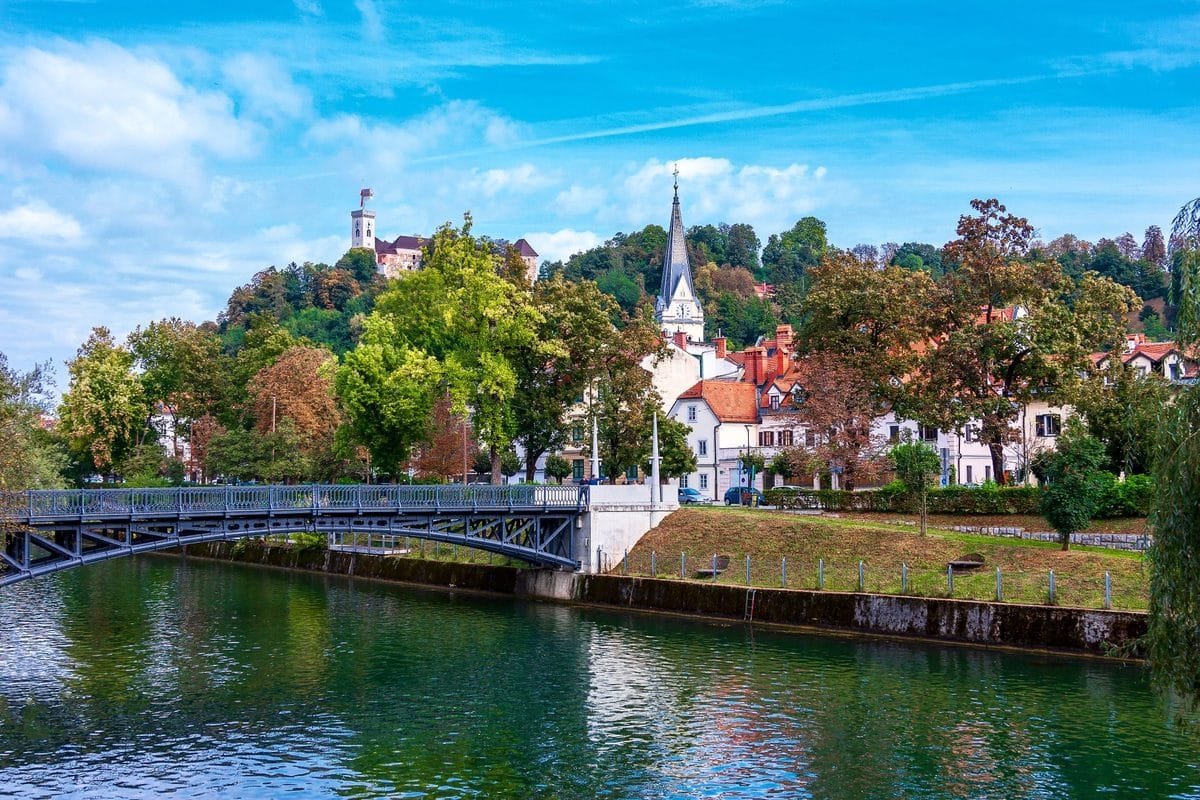
I landed in Ljubljana with a color-coded itinerary and abandoned it entirely within thirty-six hours, which is not something I do. I'm the traveler who books the museum slot six weeks out and keeps three backup dinner reservations in a note on her phone, just in case the first two are full. Somewhere between a second coffee at a café overlooking the Ljubljanica and the realization that I hadn't checked that note once all day, the plan simply stopped mattering. Slovenia's capital has a habit of doing that to people, and after five days there alone, I understood why almost nobody I know has been — and why almost everyone who has can't stop talking about it.
A Capital That Doesn't Try to Impress You
Ljubljana has around 290,000 people, which makes it smaller than most neighborhoods in the cities solo travelers usually default to — Paris, Barcelona, Rome. The entire historic core sits along a single curve of the Ljubljanica River, closed to private cars since local authorities began pedestrianizing it in 2007, so the sound you actually hear crossing Prešeren Square isn't traffic but café chatter and the occasional cyclist's bell. Tromostovje, the Triple Bridge, connects the square to the old town in about ninety seconds on foot, and from there the entire walkable center — castle hill, the riverside promenade, the open-air market — fits inside a loop you could finish in under two hours if you didn't stop. You will stop, though. Every second building along Cankarjevo nabrežje is a café with outdoor seating angled toward the water, and nobody rushes you out after one espresso, not even during peak lunch hours. This is a city built at walking pace, and for a solo traveler that matters more than any single landmark — there's no pressure to coordinate a schedule with anyone else, and nothing here is spread out enough to make that inconvenient.
What an Actual Day Alone Looks Like
My best day started at Odprta kuhna, the open-air food market that takes over Pogačarjev trg every Friday from March through October, where stalls from restaurants across the city sell lunch-portion versions of their menus for €6 to €10. I ate a plate of ćevapi standing at a shared table next to three retirees arguing about football, then walked it off with the funicular ride up to Ljubljana Castle — about €10 for the round trip plus entry, and worth it for the view over the terracotta rooftops alone, not really for the museum inside, which is skippable.
By early evening, a short walk gets you to a different kind of neighborhood entirely:
- Metelkova, the former military barracks turned squat-style arts district, where the murals alone are worth the detour even if you don't stay for a bar
- Tivoli Park, Ljubljana's largest green space, good for an hour of doing absolutely nothing on a bench
- The riverside bars south of the Triple Bridge, where a glass of Slovenian wine runs €4 to €6
- and if none of that appeals, the Central Market's covered arcade stays open late enough for a quiet browse, among other things worth wandering into on a whim
None of it requires a reservation, a group, or a plan drawn up in advance — which, three days in, was exactly the point.
Where to Stay When You're the Only Name on the Booking
Where you sleep changes the trip more than where you eat, and Ljubljana gives solo travelers two honest options rather than the usual sprawl of choices. Hostel Celica, a former military prison converted into a design hostel in 2003, rents dorm beds for around €25 a night in rooms that were once actual cells — each one redesigned by a different artist, so no two look alike, and the building itself sits close enough to Metelkova that you can walk home from a bar in under ten minutes. Book Celica over a generic hostel bed if design and story matter to you as much as price; the extra ten euros over a bare-bones dorm buys you a room you'll actually remember. If a private room matters more than atmosphere, Vander Urbani Resort sits directly on the river in the old town for around €160 a night, with a small rooftop pool that gets almost no one in it before 10 a.m. — I had it to myself twice.
The Safety Question, Honestly
Short answer: yes, and I would send my sister there alone tomorrow.
Slovenia consistently places among the highest-ranked countries in Europe for public safety, and Ljubljana's Old Town in particular has the kind of late-evening foot traffic — families walking home from dinner, groups of students spilling out of bars, older couples strolling by the river — that makes solo walking after dark feel unremarkable rather than risky. The general emergency number across the EU is 112, and Slovenia's police line is 113 if you ever need to be specific about it, though in five days I never came close to needing either. It isn't flawless, and pretending otherwise would be dishonest: the area immediately around the main train station draws a more transient crowd late at night than the Old Town does, mostly people passing through rather than anyone dangerous, but if I were arriving after 10 p.m. with luggage, I'd take the ten-minute taxi rather than the ten-minute walk. That's a small caveat in a city where the bigger risk is genuinely just tripping on cobblestones after a second glass of wine. Locals I spoke with — a shop owner near Prešeren Square, a bartender in Metelkova — both said the same thing without my asking: Ljubljana is small enough that word travels, and that keeps things quieter than a capital city usually is. Whether that's the actual mechanism or just a nice story people tell themselves, the effect on the ground is the same, and it's the reason this made my list of places worth doing entirely alone.
Getting There Without Renting a Car
Ljubljana Jože Pučnik Airport has direct flights from a decent spread of European hubs, but the more interesting routes in are overland. GoOpti, a Slovenian door-to-door shuttle service, runs shared transfers from Vienna Airport for around €25 to €35 and takes about two and a half hours — cheaper and less hassle than a rental car you'd only use for a single trip. The train from Zagreb takes roughly two hours and costs €13 to €19 depending on the class, and it's a genuinely scenic ride through the Sava valley that I'd pick over a bus even without the view. Once you're in the city, skip renting anything: the entire old town is walkable, city buses run on a rechargeable Urbana card for about €1.30 a ride, and Ljubljana's bike-share stations are dense enough that you're rarely more than a few streets from one if your feet give out.
What I'd Actually Change Next Time
Two things I'd do differently. First, I'd avoid a Monday — most of Ljubljana's museums close that day, including the City Museum, which I only discovered standing in front of a locked door with twenty minutes to spare before a train. Second, I underestimated how much I'd want a fourth day; three felt like exactly enough time to see everything and completely wrong once I was actually there, because by day three I wasn't trying to see anything anymore, just sitting by the river with a book and watching the city go about its evening. That's not really a complaint. It's closer to the reason I'd go back before I'd go somewhere new.