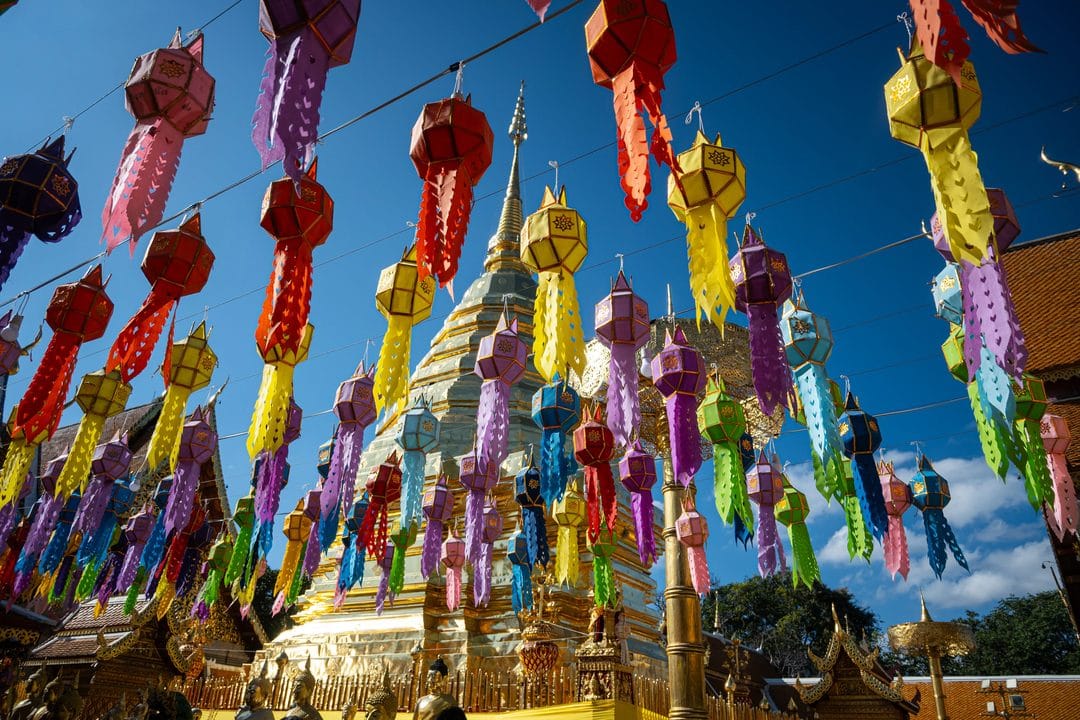
I landed in Chiang Mai with a spreadsheet. Three temples a day, a cooking class wedged between the Sunday Walking Street and a sunrise trip to Doi Suthep, a two-day buffer for "flexibility" that I had already half-filled with a waterfall tour. I had done this in six cities before Chiang Mai and it had always worked — you move fast, you tick things off, you feel productive even when you're exhausted. Chiang Mai took about four days to dismantle that entire system, and it did it without my noticing until the spreadsheet was just sitting there, untouched, while I drank a second coffee I hadn't planned on drinking.
The Old City doesn't reward rushing
Chiang Mai's Old City is a square, roughly 1.5 kilometres on each side, ringed by a moat and the remains of brick walls the Lanna kings built after founding the city in 1296. You can walk the entire perimeter in under two hours. I tried to do it as a warm-up lap on my first morning, the way I'd power-walk a historic centre in Europe to "get oriented," and I lasted about twenty minutes before a monk sweeping the courtyard at Wat Chedi Luang looked at me the way you'd look at someone jogging through a library. Nobody else was moving like that. The tuk-tuk drivers parked outside Wat Phra Singh were napping in their own vehicles. The women setting up fruit carts near Tha Phae Gate were arranging mangosteen with the unhurried precision of people who had nowhere else to be for the next six hours.
That mismatch is the whole trip in miniature, and it's worth sitting with instead of explaining away as "just the vibe." Chiang Mai wasn't built for a checklist pace, and the city doesn't accommodate one gracefully — you end up sweaty, slightly resentful, and somehow still missing half of what you came to see because you were too busy getting to the next thing. The alternative, which took me longer to accept than it should have, is to pick two temples a day instead of five and actually sit in the courtyard for twenty minutes doing nothing. Wat Chedi Luang's half-collapsed thirteenth-century chedi looks completely different depending on whether you glance at it for ninety seconds or actually watch the light move across the brick for half an hour. I only found that out because I ran out of places I felt obligated to be.
Doi Suthep is a half-day, not a box to tick
Wat Phra That Doi Suthep sits about 15 kilometres up the mountain west of the city, and most itineraries treat it as a two-hour errand: songthaew up, photos of the golden chedi and the city view, songthaew down, on to the next thing. Skip that version. The temple was founded in 1383 after — according to the local legend most guides will tell you unprompted — a white elephant carrying a sacred relic climbed the mountain, trumpeted three times, and died on the spot where the wat now stands. Whether or not you buy the legend, the 309-step naga staircase up to the temple compound is genuinely worth climbing rather than skipping via the cable car, if your knees allow it, because the ascent is part of what makes the view at the top land differently than it would after a five-minute funicular ride.
I'd recommend building in the return leg on foot too, at least partway, rather than piling straight back into a songthaew — there's a monastery trail lower on the mountain that most day-trippers never see because they're booked into a return van with eleven other tourists on a schedule. Going alone meant nobody was waiting on me to hurry back down.
What slow actually costs, and what it buys you
None of this slowness is really about willpower, if I'm honest, because Chiang Mai makes patience financially easy in a way that busier, pricier cities don't. A guesthouse room in the Old City runs roughly 500–900 baht a night (about $14–25), a bowl of khao soi — the turmeric-yellow coconut curry noodle soup that's the city's defining dish — costs 50–70 baht at a proper local shop, and a one-hour Thai massage at a reputable spot near Ratchadamnoen Road is typically 200–300 baht. Staying an extra week doesn't blow the budget the way it would in Copenhagen or Sydney. That's not a small factor: the reason Chiang Mai has such a large population of long-term visitors and digital nomads, clustered especially around the Nimman neighbourhood's cafés and coworking spaces, isn't just the temples — it's that the cost of staying still is genuinely low, so staying still stops feeling like a luxury you have to justify.
I ended up taking a half-day Thai cooking class through one of the small family-run schools near the Old City rather than one of the big tour-bus operations, mostly because a fellow solo traveller at my guesthouse recommended it over breakfast. We started at the market at 8am, learned to identify galangal versus ginger by smell (they look nearly identical and I'd been mixing them up my whole life), and spent the rest of the morning cooking five dishes from scratch, including a pad thai that bore no resemblance to anything I'd eaten at home. Book the smaller schools over the big-brand ones if you have a choice — the market visit is where the actual learning happens, and the tour-bus versions tend to skip it or rush it.
The elephant question you can't dodge
Chiang Mai is also where the elephant tourism debate gets unavoidable, and I don't think it's honest to write about this city without naming it directly. Riding camps still operate all over the region, some rebranded with "sanctuary" in the name while still offering rides and performances that welfare organisations have documented as harmful to the animals' spines and long-term health. Elephant Nature Park, founded by Sangduen "Lek" Chailert north of the city, does observation-only visits — you watch, feed, and sometimes help bathe elephants that have been retired from logging or tourism work, but you don't ride them. It's more expensive than a riding camp and books out weeks in advance in high season. Go with that model or skip elephants entirely; the middle-ground operators marketing themselves as ethical while still running rides aren't actually a middle ground. I met two women at my guesthouse who'd booked a same-day riding camp because it was fifteen dollars cheaper, then spent the drive back messaging each other trying to find the sanctuary's number instead.
Timing matters here in a way most itineraries gloss over. Visit between November and February and you get genuinely comfortable temperatures and clear mountain views from Doi Suthep. Show up between February and April, during the regional burning season when farmers clear fields ahead of planting, and the haze can sit over the valley for weeks, occasionally pushing air quality into territory that makes long outdoor days genuinely unpleasant. I got lucky with a December visit. A friend who went in March spent half her trip checking an air quality app instead of a map, which tells you something about how much that seasonal detail actually matters when you're planning around it. Check the AQI reading for the city itself before you commit to a burning-season date, not just the seven-day weather forecast, because the two numbers tell you completely different stories.
What I took out of the spreadsheet
By the end of the second week — because it did become two weeks, extended twice from a plan that originally allotted four days — I'd stopped opening the itinerary app altogether. My days had a loose shape instead: a temple or a market in the morning, a long lunch that ran an hour longer than lunch has any business running, an afternoon that might involve absolutely nothing beyond a paperback and the courtyard of whichever guesthouse I was in that week. That's not a travel strategy I'd have trusted myself to choose on purpose. It's one Chiang Mai talked me into by simply refusing to reward the alternative.
What I'd tell another woman travelling here alone, and what I mean unqualified rather than as a suggestion: don't book back-to-back day trips for your first week, and don't let a tour operator's fixed schedule decide when you leave a temple. Sit in Wat Chedi Luang's courtyard until you're bored of it, not until the tour group moves on. Chiang Mai isn't a city that punishes you for slowing down. It's one of the few places I've travelled where speeding up is the thing that actually costs you something.