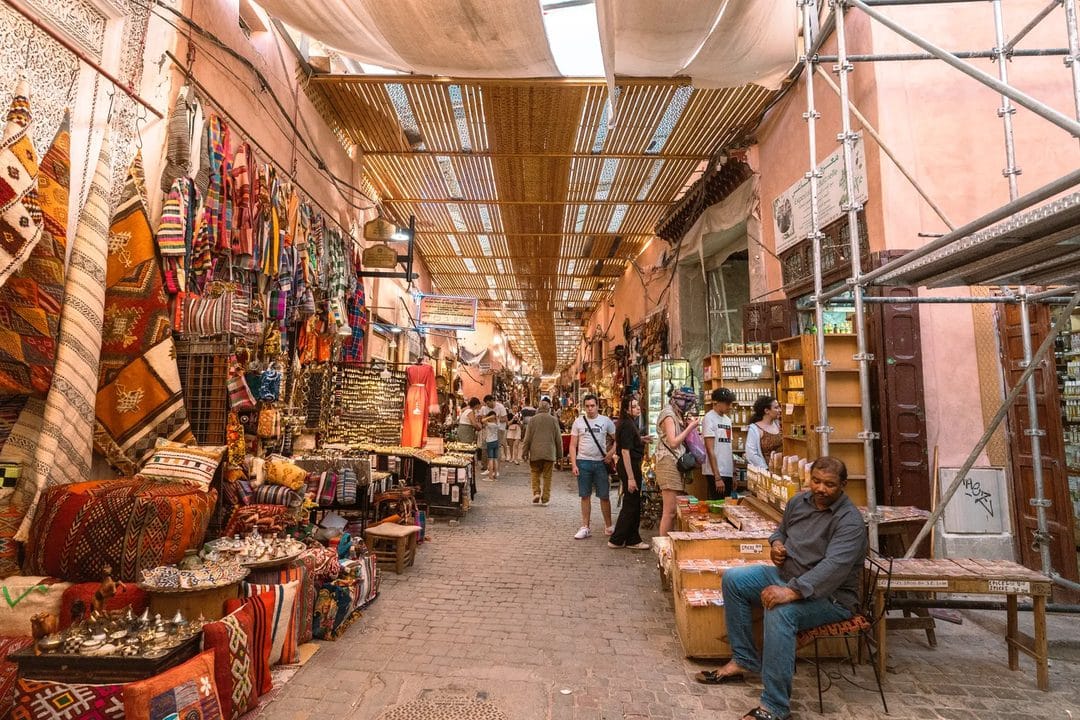
The first sound in the Marrakech medina isn't a car horn or a call to prayer — it's a bicycle bell, ringing three times in quick succession behind you before a boy on a rusted frame threads through a gap in the crowd that didn't exist a second earlier. I stepped sideways into a doorway smelling of cumin and wet plaster, and a shopkeeper I hadn't even glanced at said, "Careful, no rush here, but also always rush," which made no sense until about day three, when it made perfect sense.
I'd been told to fear this city. Not vaguely — specifically, by three separate people, including a woman who'd been here once in 2019 and never came back. The warnings were about the medina's souks, about being followed, about the particular exhaustion of constant negotiation. Some of that turned out to be real. Most of it turned out to be a version of Marrakech that stops mattering once you learn the rhythm, and by the time I left I understood why so many solo women who go once end up going back within a year.
Landing in September, not August
Marrakech in August is a city daring you to leave it. Daytime highs regularly clear 40°C, the kind of heat that turns a ten-minute walk into a logistics problem, and most riad owners will tell you their August bookings skew almost entirely toward first-timers who didn't check a weather chart. September is a different city. By the middle of the month, daytime temperatures settle into the low-to-mid 30s and evenings drop enough that a light layer stops being optional decoration and starts being useful. The light changes too — that flat, bleached midsummer glare softens into something closer to amber by late afternoon, which is exactly when the Koutoubia Mosque's 77-meter minaret starts throwing a shadow clean across the Jemaa el-Fnaa. Locals notice the shift before visitors do, because September is when the medina's own rhythm resets — shopkeepers who spent August half-closed through the worst of the heat reopen full hours, and the evening foot traffic through the souks thickens back up to something closer to normal.
This is also the window when riad rates dip before the October rush, when tour groups thin out enough that you can actually hear a fountain running in a courtyard instead of fifteen conversations layered over it. Book a riad over a hotel — not might, will — because a hotel puts you outside the medina's actual texture, and the whole point of coming to this city is the texture. A riad drops you inside a traditional courtyard house, usually two or three floors wrapped around a tiled or planted center, often with a plunge pool no bigger than a bathtub, and the difference between waking up to birdsong bouncing off zellige tile and waking up to a hotel corridor is not subtle. Expect to pay somewhere between 400 and 1,500 dirham a night depending on how many rooms the riad has and whether breakfast is included, and don't assume the pricier option is automatically the better one — some of the best mint tea I had all trip came from a nine-room riad running closer to the low end of that range.
Getting lost in the souks on purpose
The medina is a UNESCO World Heritage site, and it has been the working heart of Marrakech since the city's founding in the eleventh century, which means the layout wasn't designed for tourists to navigate — it was designed for guilds to cluster by trade, and it still mostly works that way. Souk Semmarine runs the main spine near the square, loud with textiles and leather bags. Souk El Attarine breaks off into spice and perfume stalls, cones of turmeric and paprika stacked like sandcastles, and the smell alone is worth the wrong turn it takes to find it. Souk Cherratine, deeper in, is where the tanneries' output actually gets sewn into goods, and it smells like it — sharper, more animal, less romantic than the postcard version. None of these boundaries are marked on any sign; you learn them by noticing what's being sold changes every fifty meters, then by noticing it stops changing once you've crossed into the next trade's territory. A vendor selling babouches will point you toward leather without hesitating, because sending you to a competitor two stalls down costs him nothing and buys goodwill he might collect on later.
Here's the part nobody prepares you for: getting lost isn't a failure state in the medina, it's the only way most of it reveals itself. My phone's GPS gave up entirely on the second day, spinning uselessly under three stories of covered alleyway, and I stopped fighting it. Instead I picked a landmark — the Koutoubia minaret, visible from almost anywhere once you're near the square — and let myself wander outward from it in loops, correcting only when I needed to. That's the actual skill worth learning here, more useful than any phrase book: orient to one tall, unmissable thing and stop trying to hold a mental map of streets that were never meant to be mapped in straight lines.
- Carry small bills in dirham — nobody in the souks wants to break a 200 note for a 30 dirham purchase, and the friction of that alone will sour an interaction that didn't need to go sour.
- Bargaining is expected, not optional, for anything without a printed price tag. Starting around a third of the quoted price and settling somewhere in the middle is the norm, though a genuinely skilled vendor will read your interest level faster than you'd like.
- If a "guide" attaches himself to you unprompted near a souk entrance, a flat and unhesitating "no, thank you" said once, without breaking stride, works better than any longer explanation — over-explaining reads as an opening, not a boundary.
The hammam, and why the touristy version isn't the fake version
There's a persistent idea that the "authentic" hammam experience means finding some undiscovered neighborhood bathhouse and that anything marketed toward visitors is a watered-down imitation. I don't buy that distinction, and I'll say it plainly: a well-run spa hammam, the kind with black soap, a proper gommage scrub, and an attendant who actually knows what she's doing, delivers the same core experience as a neighborhood hammam — steam, scrub, silence — minus the awkwardness of being the only foreigner in a space with its own unspoken social rules you haven't learned yet. Places like Hammam de la Rose or Les Bains de Marrakech run somewhere in the 250–500 dirham range for a scrub-and-massage combination, which is not cheap by local standards but is a fraction of what the same treatment costs framed as a "spa day" back home.
What surprised me wasn't the treatment itself — it was the quiet afterward. You walk out of a hammam wrung out in a way that has nothing to do with tiredness, skin stripped raw in the good sense, and the medina outside suddenly sounds less chaotic than it did two hours earlier. Nothing about the city changed. You did.
Jemaa el-Fnaa after dark
The square by day is markets and juice stalls and snake charmers angling for tourist photos, and honestly, that daytime version is skippable if you're short on time. The night version is not. Around sunset, dozens of open-air food stalls assemble from nothing — the same plot of ground that held orange juice carts at noon becomes a grid of grilled meat, snail soup, and msemen stands lit by bare bulbs, and UNESCO recognized the square itself as a Masterpiece of the Oral and Intangible Heritage of Humanity back in 2001, largely because of what happens here after dark: storytellers, musicians, and henna artists working the same patch their families have worked for generations.
Eating alone at a stall counter here is one of the least awkward solo-dining setups I've found anywhere, mostly because everyone is doing it, tourists and locals both, elbow to elbow on shared benches with no expectation of conversation unless you start one. Pick a stall with a line of Moroccan customers over an empty one with an aggressive tout waving a laminated menu — the queue is doing the quality control for you. Stall number 1 near the square's edge and the cluster around stalls 14 through 20 tend to draw the steadiest local crowds, though stall numbers shift season to season, so go by the line, not the number.
Out of the medina: the Atlas Mountains or the stone desert
Two very different day trips sit within reach of Marrakech, and picking between them depends entirely on what kind of quiet you're after. The Atlas Mountains rise sharply about an hour and a half southeast, and the village of Imlil sits at the trailhead for Toubkal, the highest peak in North Africa at 4,167 meters. You don't need to summit anything to feel the shift — even a half-day walk through the walnut and apple orchards around Imlil, with Berber villages stacked into the hillsides and mule trains hauling supplies up paths too narrow for cars, resets something that four days in the medina's noise had wound tight.
The Agafay desert pulls in the opposite direction, roughly forty minutes southwest, and it surprises almost everyone who's pictured Sahara-style dunes: this is a stony, rolling desert, closer to a moonscape than a beach, with none of the soft orange sand people expect. What it does have is silence on a scale the medina simply cannot offer, and if your trip is built around solo camps or sunset dinners, this is where operators pitch Berber-style tents for exactly that. I'd pick the Atlas over Agafay if you only have one day and want to actually move your legs; I'd pick Agafay if what you're chasing is stillness and you've already had enough walking for one trip.
What the warnings got right, and what they didn't
The safety conversation around Marrakech for solo women isn't invented, but it's also not the whole picture. Catcalling and persistent vendor attention are real and happen daily, more so near the square and the main souk entrances than in the quieter residential lanes further in. What's overstated is the idea that this translates into physical danger at any meaningful rate — in four days moving through the medina alone, morning until well after dark, the worst I encountered was unwanted commentary, never anything that felt like an actual threat. Dress that covers shoulders and knees cuts down on the volume of attention considerably, not because it's required by law but because it reads as respect for local norms, and that reading changes how people approach you. It's not a guarantee — I still got looked at, still got the occasional comment, and no amount of covering up erases that entirely. What it does is shift the baseline from constant to occasional, which over four days is the difference between a trip that wears you down and one that doesn't.
Taxis are where I'd actually put your caution budget. Always agree on a price before getting in, or better, ask your riad to call a taxi rather than flagging one on the street near a tourist zone, where meters conveniently stop working the moment a foreigner gets in. That single habit — riad calls the taxi — solved more friction in four days than any phrase I memorized in French or Darija.
By the last morning, I sat on the roof terrace of the riad with mint tea going cold in front of me, watching swallows cut low over the medina's rooftops while the call to prayer layered over a radio playing somewhere below. Nobody was rushing me toward the airport shuttle. I'd stopped checking my phone for directions three days earlier and hadn't needed to start again.