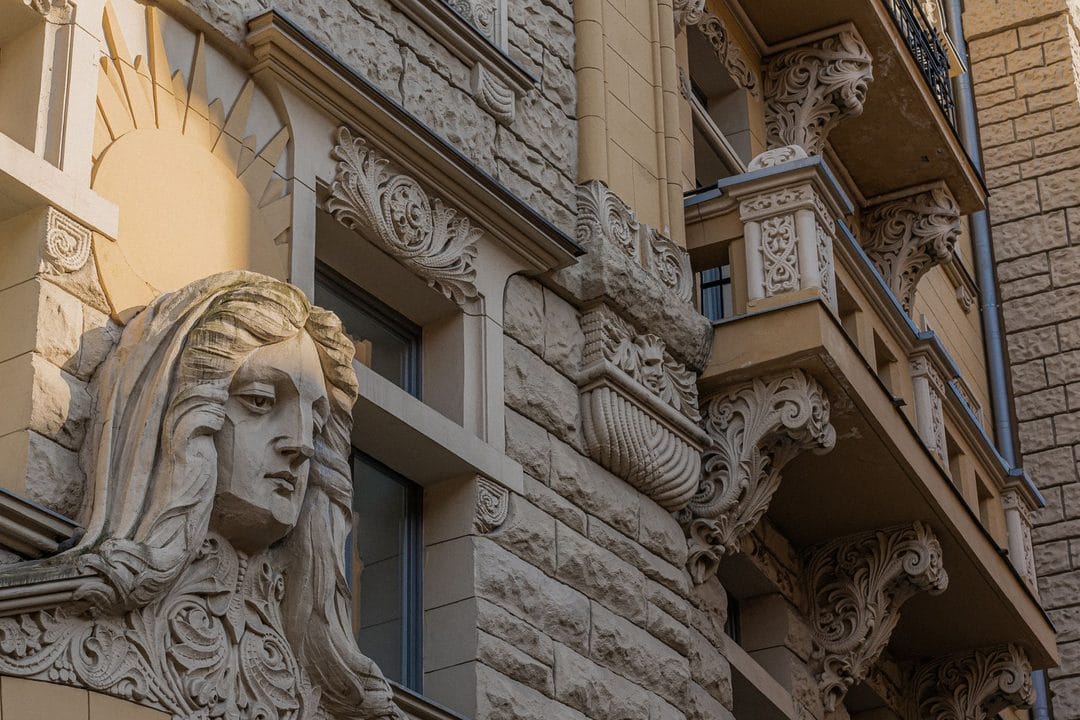
I landed in Riga expecting a stopover — somewhere to kill eighteen hours between Vilnius and Tallinn, camera out of habit rather than intent. Four days later I was standing on Alberta iela at nine in the morning, coffee going cold in my hand, counting carved faces on a single building facade and losing track somewhere around thirty. Nobody had told me Riga would be the reason I rearranged the rest of the trip.
Every solo trip through the Baltics seems to route through Riga the same way — a night or two wedged between Vilnius and Tallinn, treated as the connector city rather than a destination in its own right. I'd planned it that way too, one night, a quick loop of Old Town, an early bus onward. What actually happened is I cancelled the onward bus twice, moved hostels once to be closer to the streets I kept walking back to, and left with a half-finished list of buildings I still wanted to photograph in different light. Solo travel does that occasionally — hands you a city you had no real plan for, and it quietly rearranges the itinerary around itself. I've had it happen twice before, once in a fishing town in Portugal I'd booked for a single night and stayed in for five, and I've learned by now to just let it happen rather than fight the schedule I made months earlier from a different mood entirely. There's no way to predict which city will do it to you, which is half the reason solo travel keeps being worth the hassle of doing alone. Riga wasn't even on my shortlist before the trip — it was a cheap flight connection that turned into the best four days of a six-country loop.
The Street That Rewrote My Plans
Riga holds the largest concentration of Art Nouveau architecture anywhere in Europe, and almost none of it shows up on the postcards people actually buy. The Old Town gets the photos — the medieval spires, the cobblestones, the Freedom Monument — while a fifteen-minute walk north, the Quiet Centre district quietly outclasses it. Alberta iela is the obvious starting point: sphinxes, screaming masks, women mid-transformation into trees, stacked four and five storeys high on buildings that are still, mostly, just apartments. Walk it slowly. Then walk Elizabetes iela and Strēlnieku iela, where the crowds thin out and you can actually stand in the middle of the street without someone stepping into your shot.
Skip the guided Art Nouveau walking tours unless you specifically want the architectural history spelled out — self-guided with a downloaded map does the job for a fraction of the price, and the buildings reward slow looking more than narration. That's my honest take after doing both on separate trips.
Is Riga Actually Safe to Walk Alone at Night?
Yes, with the same asterisks that apply to any European capital. Riga consistently ranks among the safer cities in Europe for solo female travelers, and the numbers back up the reputation — reported crime against women sits at roughly 1.9%, and harassment is genuinely rare in the central districts where most visitors spend their time. That matched what I felt walking back to my hostel at eleven at night through Old Town: quiet streets, visible groups of other tourists, no sense of being watched.
The exceptions are specific, not vague. Maskavas Forštate, locally shortened to Maskačka, has a noticeably higher crime rate and isn't somewhere I'd wander after dark without a reason to be there. Central Station and the area around Origo shopping centre are pickpocket territory during the day, never mind after — keep your bag zipped and in front of you, standard advice that actually matters here. And the Old Town on a Friday or Saturday night fills up with stag parties from elsewhere in Europe; the danger isn't the drunk groups themselves, who are mostly just loud, it's the handful of bars around that scene angling to overcharge anyone who looks like a tourist. None of this is unique to Riga — every European capital has its version of Maskačka and its version of the stag-night gauntlet through Old Town. What's different here is how contained it is: two or three specific streets to route around, rather than a general low hum of caution across the whole city the way you'd need in a larger capital. I asked a woman running a stall at Central Market whether she'd walk home alone at 1am, and her answer was a shrug and "depends which street," which is about as honest a safety assessment as you'll get from a local anywhere.
One thing worth being blunt about: unlicensed taxis hovering near the airport arrivals hall and around Old Town's edges will quote a reasonable fare, then argue for triple that once you've arrived. I watched it happen to another traveler outside my hostel. Use Bolt, or a red-licensed taxi with a visible meter — never agree a fare with someone who approaches you first. If anything does go wrong, the emergency line is 112 with English-speaking operators, and Riga runs a dedicated Tourist Police unit that's used to dealing with visitors.
Getting Around Without Overthinking It
Rīgas Satiksme runs the trams, buses, and trolleybuses on one shared ticketing system, and it's cheap enough that renting a car never crosses your mind. A single 90-minute ticket costs €1.50 if you tap a contactless card, or €1.15 if you buy it in advance from a kiosk — either way it covers unlimited transfers within the window, as long as you register a new ticket each time you board a different vehicle. A 24-hour pass runs €3.60 and pays for itself after four rides, which for a full day of museum-hopping and neighbourhood walking, it usually does.
From RIX Airport, bus 22 is the one route where you can actually buy a ticket straight from the driver — €2.00, cash or card, running directly into the city centre. Everywhere else, you'll need a pre-loaded e-ticket, sold at over 400 outlets across town including most Narvesen kiosks. I bought mine at the airport within five minutes of landing and never thought about transport again for the rest of the trip.
Where I Stayed, What I Ate, What It Cost
Base yourself in Old Town. It's the most convenient option for a first solo visit — everything walkable, English spoken everywhere, a visible police presence that makes late walks back feel unremarkable — and I wouldn't recommend the Embassy district instead, even though it's technically the safest part of the city, because it's quiet to the point of dull and short on anywhere to eat after 8pm.
A realistic backpacker budget lands around €50 a day: a hostel dorm bed running €18–25 depending on season, a business lunch (dienas pusdienas) for €6–10 that usually includes soup and a main, and dinner covered by either the Lido buffet chain (€7–11, a genuine local institution, not a tourist trap) or a portion of dumplings at Pelmeni XL for €3.50–5.50. Riga Central Market deserves at least one full morning on its own — it's one of the largest markets in Europe, housed in a set of converted Zeppelin hangars from the First World War, and wandering between the pavilions for smoked fish, pickled vegetables, and fresh rye bread costs nothing beyond whatever you end up buying.
The Reserved Thing Nobody Warns You About
Latvians don't do small talk with strangers.
On my first day I mistook that for coldness. It isn't. People keep to themselves on trams and in shops as a matter of course, not because anything is wrong — eye contact and a nod get returned, but nobody's going to strike up conversation over your backpack tag or ask where you're from. It took me two days to stop reading that as unfriendliness and start reading it as just a different social default, the same way some cities run loud and others run quiet.
Once you push past that first impression, though, the city opens up in small, specific ways — a market vendor who slips you an extra pickle because you asked a genuine question about the brine, a stranger on the tram who quietly points at your stop before you miss it. Small. Not performative. That's the trade-off with reserved cultures: less warmth on the surface, more of it underneath once someone decides you're worth it.
What surprised me more was how easy the reserve made solo travel specifically. Nobody stares at a woman eating alone. Nobody hovers, offers unsolicited advice, or treats a solo table as something to comment on — you're simply another person having lunch, which after cities where solo dining draws attention, felt like a small relief I hadn't known I needed. Bring a book to the Central Market food hall and nobody so much as glances over.
Would I Go Back Solo?
I've already looked at flights for October, when the Art Nouveau facades apparently look even better against bare trees and low grey light — a season nobody mentioned to me before I went the first time. Riga doesn't announce itself the way Prague or Budapest do, and that's exactly the point: four days there, and I still hadn't finished counting the faces on Alberta iela.