Why Tbilisi Beat Santorini on My Shortlist This Year
I had a boarding pass to Athens sitting open in one browser tab and a Reddit thread about marshrutka minibus etiquette open in another, and somehow the second one won. Every solo-travel list I'd read this year pointed toward the same six Greek islands and the same three Italian coastal towns, all of them booked solid by June and priced like it. Tbilisi kept surfacing instead, usually in comments from people who'd gone for a weekend and stayed a week. So I rerouted a long weekend meant for the Aegean into five nights in the Georgian capital, expecting a cheaper Prague with worse coffee. What I got was a city built across a river gorge, half Persian bazaar and half Soviet apartment block, with a cable car gliding over both. That contrast is the whole pitch, and no single photo of it does the place justice.
The One-Year Visa Nobody Mentions Until You're Reading the Fine Print
Georgia has offered visa-free entry of up to 365 days to citizens of the United States, the United Kingdom, every EU member state, and dozens of other countries since 2015 — a policy most first-time visitors don't expect from a country wedged between Russia, Turkey, Armenia, and Azerbaijan. You land at Tbilisi International Airport (officially Shota Rustaveli Tbilisi International Airport), hand over your passport, and walk through with a stamp and no visa fee, no pre-approved e-visa, no interview. That single fact quietly reshapes the whole trip: instead of squeezing Tbilisi into a nine-day Schengen-adjacent itinerary, you can treat it like a base and disappear into the Caucasus for as long as your return flight allows. I met two American women at my guesthouse who'd originally booked ten days and were three weeks in, working remotely from a co-working space near Fabrika, a former Soviet sewing factory now packed with cafés, a hostel, and vinyl shops.
What a Realistic Day Actually Costs in Lari
The local currency is the Georgian lari (GEL), and it stretches further than most European currencies you'll have used recently. A plate of khinkali — the soup dumplings you eat by hand, never with a fork — runs 2 to 3 GEL apiece at an unpretentious spot like Racha's Corner near Fabrika, and six of them is a full meal. A 15-minute Bolt ride across the city center typically lands between 8 and 12 GEL. A private double room in an Old Town guesthouse runs 120 to 180 GEL a night; a hostel dorm bed is closer to 25 to 35 GEL. Skip the currency-exchange kiosks lining Rustaveli Avenue — the posted rate is consistently worse than what you'll get pulling lari directly from a TBC Bank or Bank of Georgia ATM, and both chains have machines every few blocks downtown. That's not a minor tip; over five days it's the difference of an extra dinner out.
Getting Around Without Uber: Bolt, Yandex Go, and the Marshrutka Learning Curve
Uber does not operate in Georgia. The two ride-hailing apps that do are Bolt and Yandex Go, and you'll want at least one installed and linked to a card before you land, because hailing a taxi off the street in Tbilisi is a fine way to overpay by three or four times the app rate. Marshrutka minibuses are the other option, and they're the cheapest way to move around the city — usually 50 tetri to 1 lari per ride, paid in cash to the driver as you board or exit depending on the route. Stops aren't always marked, drivers announce them in Georgian only, and the vehicles fill past what looks like capacity before pulling away.
Bolt is the better call for your first 48 hours in the city.
Once you've got a feel for the main routes — the ones running down Agmashenebeli Avenue or out toward Vake Park are the easiest to learn — marshrutkas become genuinely useful. Locals wave down drivers or bang on the ceiling to signal a stop, the way you'd press a button on a city bus back home. It's not a system built for tourists, and it doesn't apologize for that, which is honestly part of the appeal once you've cracked it.
The Cable Car to Narikala Fortress, and the View That Justifies the Wait
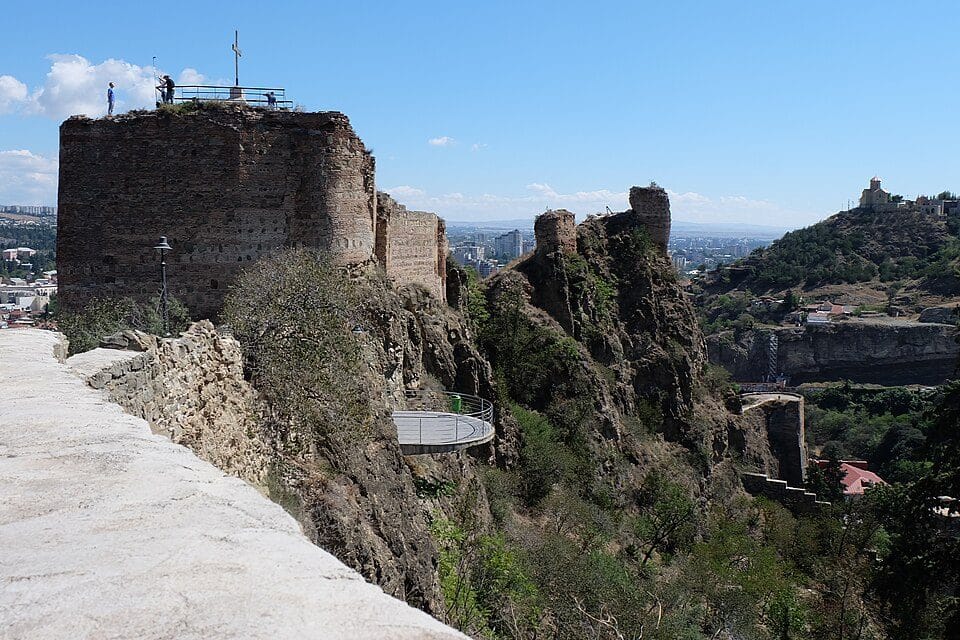
The gondola connecting Rike Park to Narikala Fortress opened in 2012 and remains the fastest way up the hill that dominates Tbilisi's skyline. The ride itself takes under three minutes and costs roughly 1 lari, deducted from the same Metromoney card you'd use on the metro or city buses — buy one at any metro station kiosk for a small refundable deposit. At the top, you're standing beside the fortress ruins with the Aluminum Mother of Georgia statue looking out over the Mtkvari River, the Old Town's patchwork of tin roofs and wooden balconies directly below, and the golden dome of Sameba Cathedral visible across the water on a clear afternoon. Go on a weekday morning if you can manage it — by early Saturday afternoon the queue for the gondola back down can run past 30 minutes, and there's no shade at the platform.
Abanotubani's Sulfur Baths, Explained Properly This Time
The brick-domed bathhouse district of Abanotubani sits at the southern edge of the Old Town, fed by natural sulfur springs that give the whole neighborhood a faint mineral smell you'll notice before you see it. Chreli-Abano, with its striped tile facade, is the most photographed building in the district, but Orbeliani Baths (also called Bath House No. 5) is where most solo visitors end up, because you can book a private room by the hour rather than share a communal pool with strangers. A private room for up to four or five people runs roughly 60 to 80 GEL for an hour, split however many ways you like; the communal sections cost a few lari and operate on separate men's and women's floors. Alexandre Dumas wrote about bathing here during his 1858 journey through the Caucasus, and the ritual hasn't changed much since — you sweat in a hot pool, get scrubbed down with a rough kessa mitt if you book the attendant service, and leave your skin feeling like it's been through a factory reset. It's not glamorous, and the changing rooms in the older sections are basic at best. Book it anyway; nothing else on the trip resets a body that's been walking cobblestones for three days quite as well.
Church Etiquette at Sameba Cathedral, or How to Skip the Scramble at the Door
Holy Trinity Cathedral, universally called Sameba, was completed in 2004 and stands just over 100 meters including its cross, making it one of the tallest Eastern Orthodox cathedrals anywhere in the world. Women need a headscarf and are expected to have their shoulders and legs covered, with a wrap skirt over trousers if that's what you're wearing that day. The cathedral does loan scarves and wraps for free at the entrance, but the bin runs low by mid-morning on weekends, and I watched three separate women get turned away at the door while a fourth waited ten minutes for a returned scarf. Bring your own — a lightweight scarf folds into nothing and covers you for every Orthodox church you'll pass on a Georgia trip, not just this one.
Is Tbilisi Actually Safe for a Woman Traveling Alone?
Yes, with the same ordinary caveats that apply to any capital city of over a million people. I walked Rustaveli Avenue and the wider Old Town alone after dark on four separate nights and never felt the low-grade tension I've felt doing the same in parts of Rome or Barcelona. That said, Vake Park's quieter interior paths and the residential streets climbing toward Mtatsminda thin out fast once the sun sets, and I'd route around them after dark the way I'd route around any unlit park at home. Petty theft is rare by regional standards; the more common friction is simply the language barrier, since English fluency drops sharply once you're a few streets off the main tourist corridors and most signage outside downtown is in Georgian script alone. Learn to recognize your guesthouse's street name in Georgian letters before you go exploring — it saved me twice.